Leading Agentic AI Initiatives
Data-Drive Leadership
Modern Data Foundations
Leading Data Science
LLM Leadership Advantage
AI Evals For Leadership Predesigned Program For Your Leadership
bring your own data and witness the training outcomes
Data is highly valuable digital asset that is only expected to grow over time.
Enterprises are investing heavily in building strong data analytics teams to ensure sustainable growth, but finding appropriate talent to develop customized data-driven solution is a challenge.
There is a significant talent gap, and training existing employees for new skills is advantageous for organizations, as they have domain expertise, making it easier to teach them new skills.
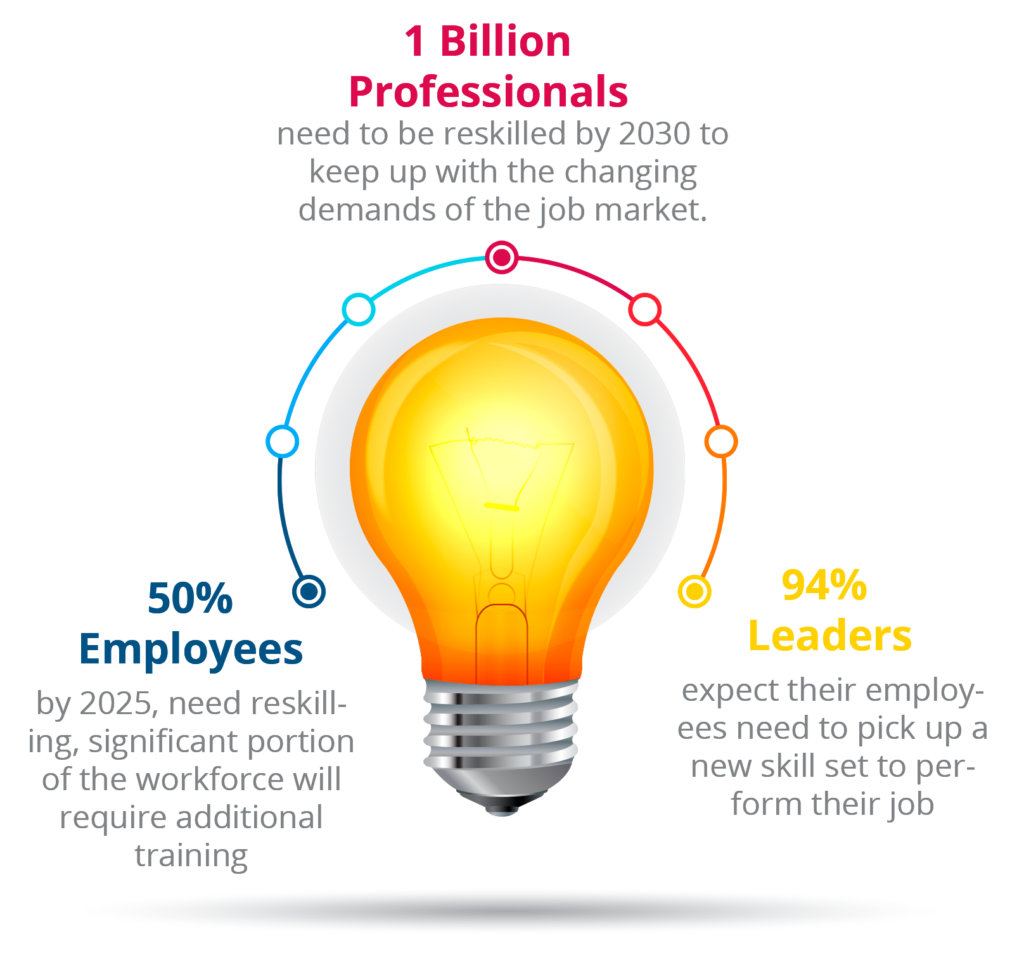
On right, statistics from World Economic Forum are shown [Upskilling Revolutions Is Inevitable!]
Our philosophy for the trainings.
Our pre-designed programs are tailored to meet today’s corporate needs and are highly valued by our clients. Our philosophy, ‘Bring Your Own Data,’ ensures that you and your leadership team can directly see the impact of our solutions. While it requires extra effort on our part, nothing makes us happier than seeing our clients succeed.
Individual program details
data-driven leadership
instructor-led
onsite/remote
Certification
20 hrs
Overview:
This 20 hours [recommended] training equips executives and non-technical leaders with essential skills to harness data for informed decision-making.
Participants will define and leverage Key Performance Indicators (KPIs), understand data’s role in organizational processes, and explore data fluency’s impact on communication and strategic planning.
Through practical workshops and case studies, attendees will gain proficiency in designing and leading data-centric projects, enabling them to drive sustainable business outcomes in this data-driven world.
Business Outcomes:
Understand and develop data-driven mindset for leadership.
Define a prioritize KPI’s critical to organizational success
Integrate data fluency into communication and decision-making processes.
Create and lead high-performing data-centric teams through collaboration and effective communication
Identify business problems and their data-centric solutions while implementing ethical guidelines for responsible data use.
Target Audience:
Executives, senior managers, decision makers and professionals seeking to enhance their understanding of data-driven decision- making principles and practices.
Module 1:
Value of Data to an Organization
Explore and examine how data drives growth, efficiency, and competitive advantage by uncovering market trends, enhancing customer experiences, and optimizing operations with real-world examples.
Module 2:
Define Concepts and Roles in Data Project
Learn to build data projects, key roles and their contributions to successful data project outcomes. Conduct a high-level gap analysis for data skills to identify critical roles for hire.
Module 3:
Data Fluency and Communication
Understand the importance of data culture, data fluency, and techniques for improving data literacy. Explore strategies for effectively communicating complex data insights within the organization.
Module 4:
Digital Decisioning and KPIs
Build KPI’s for modern organization and integrate them with digital decision-making tools. Identify and monitoring relevant metrices to align with organizational goals and drive continuous improvements.
Module 5:
Risk and ROI
Examine potential risks, including data privacy and security issues, and learn to calculate and communicate ROI of data projects. Learn to make strategies for balancing risks and benefits to make informed decisions.
Introduce your leadership and teams with the fundamental concepts in data management, focusing on relational and non-relational databases, and creating Cloud based data solutions.
Participants will learn database design principles, SQL/T-SQL querying, and how to manage data workloads on Cloud such as Azure.
This training blends theoretical knowledge with practical skills, preparing you and your team to manage and utilize data and optimize business data processes to effectively achieve operational and strategic objectives.
Business Outcomes:
Understand the importance of data, its sources and consumption in business.
Use data-driven insights for making strategic decisions and managing projects.
Create and lead high-performing data science teams through collaboration and effective communication.
Identify business problems that can be solved using data science and ensure ethical practices while driving successful outcomes.
Target Audience:
Executives, senior managers, professionals in data, analytics and IT landscape seeking to enhance their understanding of modern data storage and engineering strategies for scalable cloud-based data management solutions.
Module 1:
Data Fundamentals and Storage Needs
Learn about the importance of data, its types and sources in businesses. Explore modern data storage technologies and learn to make effective strategies for its secure storage following the best practices for corporate data.
Module 2:
Database Concepts
Explore key concepts and terminologies in databases. Overview design principles, objectives and implement them in your selected organization for effective storage and efficient retrieval of the corporate data.
Module 3:
Building and Managing Databases
Identify subjects, select entities and define keys for establishing relationships and their cardinality. Importance of normalization and schema design. Build and configure cloud databases for data migration and management.
Module 4:
Introduction to SQL/T-SQL
Learn basic querying techniques and common operation to work with data using SQL/T-SQL. Expand you understanding on retrieving data using join operations. Explore the built-in SQL/T-SQL functions.
Module 5:
Cloud Data Solutions
Explore Azure data services and common data workloads. Learn to setup cloud storage, relational and non-relational databases. Build a cloud data architecture for your selected organization in your final project.
Specifically designed for executives in managerial roles who aim to establish and lead data science teams and projects.
The training emphasizes strategic considerations over coding skills.
The participants will develop a profound understanding of data science principles and learn how data-driven insights can significantly impact the organization.
Engaging group exercises and discussions will enable executives to skillfully plan and execute data science initiatives, leveraging their newfound expertise from the program.
Business Outcomes:
Understand how data science can transform businesses strategically.
Use data-driven insights for making strategic decisions and managing projects.
Create and lead high-performing data science teams through collaboration and effective. communication
Identify business problems that can be solved using data science and ensure ethical practices while driving successful outcomes.
Target Audience:
Executives, senior managers, decision makers and professionals seeking to enhance their understanding of data science principles and practices, enabling them to effectively lead data science teams and projects in their organizations.
Module 1:
Understand The Data Science Myth
Learn about data science, its strategic impact and importance, terminology and how to identifying opportunities for data-driven applications in various industries, group exercise.
Module 2:
Identify Talent Needs and Team Structure
Learn to Build and lead data science teams. Understand data-driven organizational structure, roles and how to hire appropriate data science talent with effective strategies, group exercise.
Module 3:
Identify Pressing Problem and Solution
Learn to Identify and frame business problem for data science solution in your corporate setup. Explore key metrices and success criteria aligned with business objectives, group exercise.
Module 4:
Predict and Plan Your Next Move
Learn to Leverage data for decision-making, EDA, descriptive and diagnostic analytics, Importance of predictive modeling and data driven strategic planning, group exercise.
Module 5:
Risk, ROI and Data Science Projects
Explore principles and methodologies for data science projects. Set goals, milestones and timelines. Explore potential risks, impact and ROI in the business, Group exercise.
This high-impact program equips business and technology leaders with unified understanding of Large Language models (LLMs) and how use them to unlock enterprise value.
This intensive training demystifies LLMs, clarifies their business relevance, and prepare leadership to drive AI-enabled transformation and strategy.
Participants will learn how to identify opportunities, evaluate solutions, and guide teams in implementing responsible, ethical, scalable LLM initiatives aligned with strategic objectives.
Business Outcomes:
Understand how LLMs transform business models, decision-making, and operations.
Identify high-value opportunities that deliver measurable ROI.
Bridge communication gap between business and technical teams.
Apply RAG, fine-tuning, and enterprise architecture concepts to real use cases.
Strengthen governance, security, and responsible AI practices.
Build a practical, actionable roadmap for LLM adoption.
Target Audience:
Executives, senior managers, directors, product leaders, strategy teams, and decision makers seeking to deepen their understanding of LLMs and generative AI to guide successful adoption in their organizations.
Module 1:
Demystify LLMs & Generative AI
What LLMs are and how do they work. Foundations, terminology, capabilities and their industry impact. Myths vs realities, and framing AI opportunities. Includes group exercise.
Module 2:
Talent, Architecture & Readiness
Roles, team structure, platform and vendor selection, data readiness, governance, and enterprise LLM architecture fundamentals. Includes group exercise.
Module 3:
Identify High-Value Use Cases & RAG
Identifying and prioritizing impactful business problems and evaluating their feasibility. Designing Retrieval-Augmented Generation (RAG) workflows. Includes group exercise.
Module 4:
Customization & Deployment of LLMs
Customization & scaling in production. Fine-tuning, model evaluation, security, MLOps. Chat-bots, agents & decision-support systems. Deployment considerations. Include group exercise.
Module 5:
Risk, ROI & LLM Strategy Roadmap
Governance, adoption, and leading sustainable transformation. Organizational enablement, milestones, governance, and a 30-60-90 day adoption plan. Group exercise & capstone strategy design.
Artificial intelligence is no longer a technical experiment but a leadership decision with strategic, ethical, regulatory, and reputational implications.
This executive-focused course equips leaders with practical AI evaluation frameworks to assess value, risk, data quality, model performance, and lifecycle readiness.
Using real-world examples and deployment monitoring, participants learn to make confident, defensible, and board-ready AI decisions across public and private sector environments.
Business Outcomes:
Evaluate AI initiatives using a structured, defensible executive framework.
Align AI investments with strategic and public-value objectives.
Identify and mitigate ethical, legal, and reputational AI risks early.
Establish clear governance, oversight, and accountability mechanisms with full control.
Monitor AI systems post-deployment to ensure sustained performance and trust using right lifecycle metrics.
Target Audience:
Board members, senior executives, public-sector leaders, and technical leaders responsible for approving, governing, or scaling AI initiatives. Designed for decision-makers who must balance strategic value, technical reality, and public accountability.
Module 1:
AI Evals – Leadership & Governance Responsibility
AI failures are leadership failures. Establishes AI evaluation as a core responsibility of executives and boards, not just technical teams. Learn how evaluation protects trust, accountability, and institutional credibility.
Module 2:
Evaluating AI Value, Use Cases & Strategic Fit
Learn how to evaluate that AI initiatives truly serve strategic or public objectives. Focus on prioritization, value-for-money, and outcome-driven decision-making
Module 3:
Data & Model Evaluation
Most AI risks originate in data and models long before deployment. Assess data quality & model performance without needing technical depth. Gain confidence to challenge assumptions and demand evidence.
Module 4:
Risk, Ethics & Regulatory Evaluations
AI systems can amplify risk at scale if not governed responsibly. Focuses on evaluating ethical, legal, and reputational impacts before they become public failures. Embed trust and compliance into AI decisions.
Module 5:
Lifecycle, Monitoring & Evaluation
AI evaluation does not end at deployment, it intensifies. Learn how to monitor AI performance, risk, and drift over time. As an executives, you must learn how to retain control through ongoing oversight and decision gates.
Agentic AI represents the next major shift in enterprise AI – from systems that analyze and recommend to systems that can plan decide, and act autonomously within defined business goals and guardrails. As these technologies rapidly move from labs into core business operations, leaders are now accountable not only for adoption and value creation, but also for governance, risk, and strategic alignment.
Through real-world use cases, executive frameworks, and guided exercises, participants learn how to confidently identify high-impact opportunities, challenge assumptions, set the right level of autonomy, and govern agentic systems with accountability which leads responsible adoption. The course enables the participants to turn agentic AI into a strategic advantage rather than a technical experiment.
Business Outcomes:
Evaluate where agentic AI can drive real business value across functions (marketing, operations, customer service, product, supply chain).
Develop a strategic roadmap for pilot, scaling, and ROI measurement of agentic AI initiatives.
Assess risks and governance needs, including safety, compliance, explainability, and ethical considerations.
Lead cross-functional teams to implement AI solutions that augment human work rather than replace it.
Create a business case and investment plan tied to measurable outcomes (revenue, cost, experience, innovation).
Target Audience:
Board members, senior executives, C-suite leaders (CEO, COO, CFO, CIO, CDO), business unit heads, strategy and innovation leaders, product and operations leaders, transformation and digital leaders, AI and data program sponsors, governance and risk leaders.
Module 1:
Agentic AI Fundamentals for Business
Understand what agentic AI is, how it differs from traditional and predictive machine learning, and its relevance to business strategy.
Module 2:
High-Value Use Cases & Competitive Benchmarking
Identify where agentic AI is already delivering value across industries and assess which use cases are most relevant and realistic for the organization.
Module 3:
Building a Business Case & ROI Framework
Enable leaders to evaluate and justify agentic AI investments using clear financial and operational metrics.
Module 4:
Risk, Governance & Responsible AI Oversight
Prepare yourself to govern agentic AI systems responsibly. Understand risks, regulatory expectations, and the balance autonomy with control and accountability.
Module 5:
Organizational Readiness & Change Leadership
Equip the leadership to guide organizational adoption by aligning people, processes and operating models for sustainable use of agentic AI.