Python For Data Science
Microsoft Fabric
Analytics & Dashboards
Time Series Analysis
NLP & Business
Business Machine Learning
Mastering Power BI
Neural Networks & Business
Microsoft Fabric
Database Clients Predesigned Program For Your Teams
bring your own data and witness the training outcomes
Data is highly valuable digital asset that is only expected to grow over time.
Enterprises are investing heavily in building strong data analytics teams to ensure sustainable growth, but finding appropriate talent to develop customized data-driven solution is a challenge.
There is a significant talent gap, and training existing employees for new skills is advantageous for organizations, as they have domain expertise, making it easier to teach them new skills.
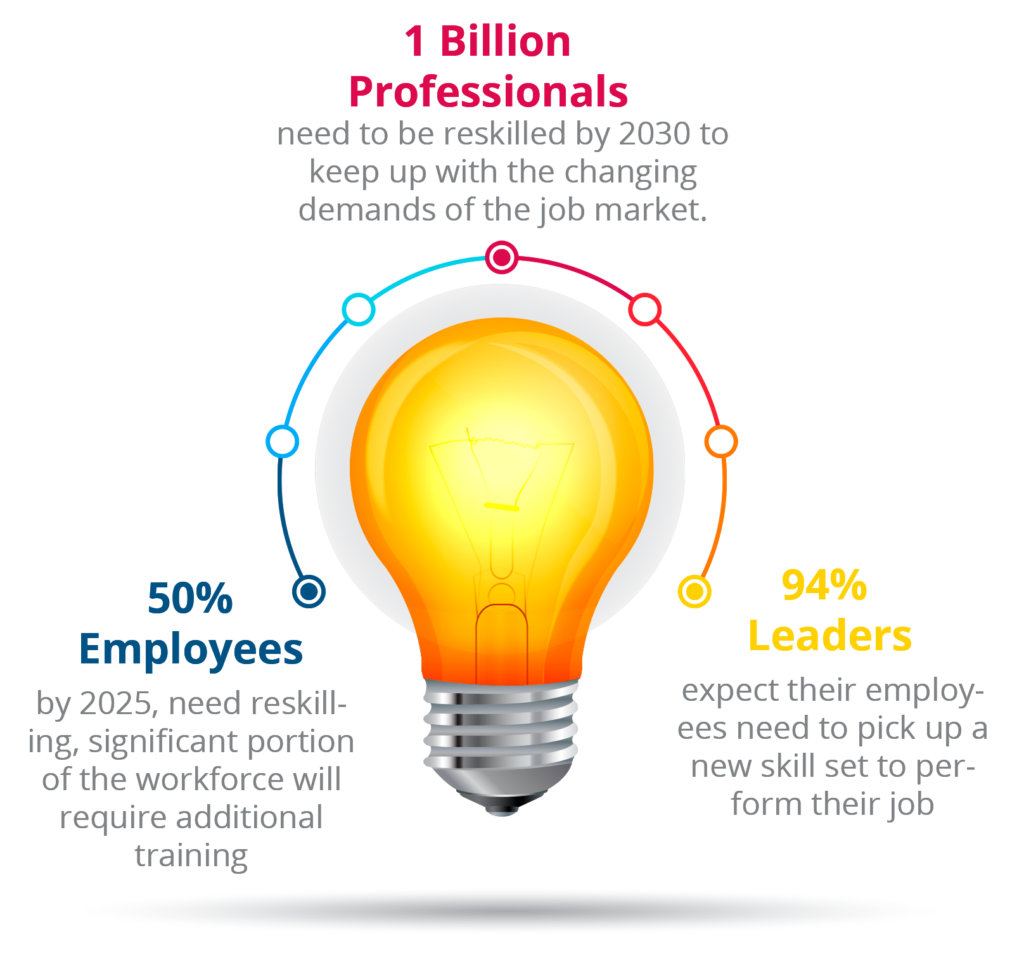
On right, statistics from World Economic Forum are shown [Upskilling Revolutions Is Inevitable!]
Our philosophy for the trainings.
Our pre-designed programs are tailored to meet today’s corporate needs and are highly valued by our clients. Our philosophy, ‘Bring Your Own Data,’ ensures that you and your leadership team can directly see the impact of our solutions. While it requires extra effort on our part, nothing makes us happier than seeing our clients succeed.
Individual program details
python for data science
instructor-led
onsite/remote
Certification
30 hrs
Overview:
This course is specifically designed for professionals and teams who seek to unlock the power of Python in data science.
Participants will gain practical knowledge with hands-on experience of Python and its powerful libraries within the data science ecosystem.
With strong focus on enhancing data manipulation and analysis skills, the course will empower the participants to effectively leverage Python for data-driven insights and decision-making.
Business Outcomes:
Proficiency in Python programming covering the fundamental concepts.
Data manipulation, wrangling and efficient data analysis.
Improved data management and enhanced productivity using effective utilization of technology and resources.
Foundation for further growth and automation.
This course includes daily group exercises and hands-on lab sessions along with home-work to reinforce learning objectives. Participants will actively apply Python programming concepts and utilize NumPy and Pandas for data analysis on real-world data.
Target Audience:
Managers, early career professionals and analysts who are interested in utilizing Python for data science applications and develop data analysis skillset.
Module 1:
Learn Required Programming Skill
Set the foundation and learn essentials of Python programming language, setup environment for data science projects.
Module 2:
Data Science Ecosystem in Python
Learn about the tools such as NumPy and pandas, explore their built-in functionalities for data analysis and manipulation.
Module 3:
Make Your Data Meaningful
Understand data cleaning, preprocessing and wrangling using NumPy and pandas, descriptive statistics and data transformation.
Module 4:
Analyze and Visualize Patterns
Exploratory data analysis and visualizations using pandas library’s built-in functionality, understanding patterns and distributions in the data.
Module 5:
Automate, Report and Communicate
Automation, reporting and communicating insights from the data for informed decision making, capstone project.
advanced analytics & interactive dashboards using python
instructor-led
onsite/remote
Certification
60 hrs
Overview:
This course is designed to enhance participant’s knowledge and expertise on advanced analytics, reporting and dashboarding using Python.
Participants will learn advanced techniques in data manipulation and analysis. They will explore how to use SQL within Python for data querying from MySQL databases and create visually appealing and informative plots and interactive dashboards.
The course will cover range of data science libraries including NumPy, pandas, matplotlib, seaborn, MySQL/Python connector, statsmodels etc.
Business Outcomes:
Gain advanced skills in data manipulation, analysis, and visualization.
Acquire proficiency in using SQL within Python for data querying.
Create visually appealing plots and interactive dashboards.
Apply advanced analytics techniques to uncover patterns, trends, and opportunities within the data.
Future-ready workforce with advanced skillset.
Target Audience:
Data analysts, Business analysts, and early career professionals seeking advanced skills in data analysis, visualizations, and interactive dashboard development for reporting.
Module 1:
Accessing Database using Python
MySQL databases, database clients, working with SQL queries using Python for retrieving and storing the data into the databases. Group exercise/homework.
Module 2:
Advanced Skills In Data Manipulation
Advanced techniques for data cleaning, preprocessing, wrangling, aggregation, and transformation. Working with missing data, group exercise/homework.
Module 3:
EDA & Business Statistics
Creating customized plots, business statistics, distributions and statistical data visualizations, relationships and patterns in data, group tasks/homework.
Module 4:
Interactive Visualization & Dashboards
Interactive visualization and choropleths. Dashboard and its components. Creating interactive dashboards using Python, group exercise/homework.
Module 5:
Capstone Project To Maximize Learning
Principles and methodologies for reporting data insights,, goals, milestones and timelines, capstone project and final presentation for evaluation.
This exclusive program is specifically designed for your existing analytic teams, new employees and fresh graduates.
The program present the role of artificial intelligence with hands-on experience in applying machine learning techniques to real-world data.
Participants will learn to preprocess data for machine learning. They will apply various advanced algorithms for predictive modeling and learn techniques to evaluate their performance.
In the capstone project, the participants can apply their skills to your own corporate data for maximum learning and practical application.
Business Outcomes:
Develop solid understanding of the role of machine learning in data-driven business.
Gain hands-on experience in end-to-end machine learning projects including risk assessment and customer segmentation.
Understand the interpretability of machine learning models and how to optimize them.
Future-ready employees and workforce to take your organization to the next level.
Target Audience:
Data analysts, Business analysts, fresh graduates, and early career professionals who wants to understand the role of AI in the organization and develop practical skills in machine learning for data-driven decision-making.
Module 1:
Introduction to Machine Learning
Learn about machine learning, ethics and fairness in business sector, solidify you understanding by learning about the use cases and start working on your own data to train your first model.
Module 2:
Supervised Machine Learning
Get deeper understanding of supervised machine learning for regression and classification. Explore how these models will help you to solve pressing issues including risk assessment and future planning.
Module 3:
Unsupervised Machine Learning
Understand the importance of clustering techniques and explore how these algorithms can help you learn user behaviour and customer segmentation for effective business strategies.
Module 4:
Present And Deploy Your Best Model In Capstone Project
Bring your own data and train a model to resolve your pressing problem. Learn how to interpret your trained model get the best for your dataset. Deploy your model, create a dashboard or present a report to your leadership and fellows.
This course is designed for your financial teams and professionals who are interested in gaining a comprehensive understanding of time series data, its analysis and business application.
Participants will explore and learn range of techniques and tools to effectively analyze and interpret time-dependent data, enabling them to make informed decision in a dynamic and evolving industry in this era of digitalization.
Capstone project is included based on “bring your own data” for maximum learning and practical application.
Business Outcomes:
Enable your employees to effectively analyze time series data for informed decision-making.
Develop skillset to forecast for your business needs accurately and reliably.
Enable your team to identify and assess volatility and risk from data and develop risk management strategies.
Future-ready workforce with skillset in advanced time series analysis techniques for handling complex time dependent data.
Target Audience:
Financial teams, financial analysts, risk managers, quantitative analysts, and anyone involved in time series data analysis for their business needs.
Module 1:
Time Series Data and Python
Develop solid understanding of time series data and its importance in decision making, explore the tools and techniques in Python to process time series data.
Module 2:
Time Series Modeling and Forecasting
Understand the modeling concepts for time series and learn forecasting techniques and how they are implemented with hands-on training using Python.
Module 3:
Seasonality and Trend Analysis
Understand the importance of key features in time series data and how they are impacting business decisions, discuss your business and importance of trends.
Module 4:
Volatility Modeling and Risk Assessment
Learn volatility and risk for your business and how to mitigate them from historical data modeling and forecasting, work with GARCH and ARCH models.
Module 5:
Advance Topics and Capstone Project
Get introduced to the advance topics in time series and learn to evaluate and select appropriate model for your data in the capstone project.
This course will equip the participants with advanced understanding of utilizing deep neural networks for predictive modeling.
Specifically designed for professionals with diverse background across the organization, the course focuses on practical implementation of neural network models for range of business tasks, enabling participants to develop hands-on skills.
Capstone project is included, allowing participants to bring their own data and gain valuable experience in real-world application for maximum learning and practical application.
Business Outcomes:
Understanding of artificial neural networks and their architectures.
Enable your employees to effectively develop deep learning models for enhanced and informed decision-making.
Develop proficiency in your team of implementing various neural networks architectures for risk sentiment analysis, assessment, forecasting, portfolio optimization and much more.
Develop employees and your workforce capable of advanced skillset for your own business optimization.
Target Audience:
Mid-level professionals and data-related roles, such as advanced analysts, financial and business analysts, risk analysts, marketing and operation managers/analysts. Participants are expected to have a basic understanding of data analysis and business concepts.
Module 1:
Deep Learning & Business Applications
Gain the most valuable knowledge and hands-on skill to work with artificial neural networks, learn about the best available frameworks for their business implementation.
Module 2:
Building & Training Neural Networks
Develop most advanced and trusted deep learning models, help your organization to effectively achieve strategic objectives with hands-on implementation.
Module 3:
Forecast & Understand The Market
Advance your team’s skillset and develop highly trusted artificial neural networks architectures for day-to-day business tasks, including forecasting, churn prediction, personalized service and more!
Module 4:
Deep Learning & Business Optimization
Understand, explain and implement deep learning algorithmic to optimize business, use data-driven strategies and increase your likelihood of winning the world of business.
Module 5:
Capstone Project For Practical Learning
Deploy, monitor and maintain your developed deep learning models, maximize your learning and solidify your skills by working and presenting a capstone project on our own data.
The participants will develop the ability to analyze and extract valuable insights from unstructured textual data, unveiling patterns, sentiment, and customer expectations.
This unique skillset of Natural Language Processing (NLP) will empower your team to make informed decisions with comprehensive understanding of customer behavior, market trends and emerging risks.
The course will enhance the ability of your analysts and help them to drive actionable insights and maximize the potential unstructured data assets of your organization.
Business Outcomes:
Gain insights from customer feedback and sentiment to enhance customer satisfaction and personalize services.
Automate manual processes such as document classification and compliance monitoring, saving time and reducing error.
Leverage NLP techniques and train advanced models to detect and prevent fraud, manage risks, and minimize financial losses.
Develop an in-house local workforce with advanced NLP skillset for business optimization and data-driven strategies.
Target Audience:
Your employees in marketing and customer service teams and related roles who wants to utilize language data to enhance their daily business operations. Machine learning engineers, Junior data scientists, Data analysts, financial, risk and quantitative analysts in your team.
Module 1:
NLP, Business & Python
Learn about the importance and role of language data in business,. Role of Python in preprocessing such complex NLP data. Gain understanding of machine learning in the context of NLP.
Module 2:
Know Your Customer’s Sentiment
Develop a skillset to mine the text such as customer feedback to understand your customer’s behaviour and provide personalized business service for retention and relationship building.
Module 3:
Capture The Context in Textual Data
Learn state-of-the-art pre-trained models for words embedding and capture the context of the text. Train machine learning models with word embeddings for enhanced performance.
Module 4:
Text to Streamline Operations
Develop document classification and claim sorting algorithms. Automate compliance monitoring and enhance business decisions, Build NLP driven business and risk management strategies.
Module 5:
Capstone Project
Maximize your learning and solidify your skills by working and presenting a capstone project, you chance to bring your own data for valuable experience or work with the given one.
This course is to empower your non-IT professionals to excel in data-driven decision-making.
The participants will learn to create BI solutions with Power BI and develop reports and dashboards independently to fulfill your business data needs.
They will master the solution development and complex problem-solving by applying rules, organize data models, and visualize with charts, graphs, maps, and gauges.
To maximize the learning, the participants will deploy a solution dashboard to Power BI Service and make it accessible across devices.
Business Outcomes:
Enhance data-driven decision making by equipping your employees to excel in advanced analytics.
Automate manual processes and streamline business insights by developing seamless live BI dashboards.
Develop data transformation skillset in you employees to effectively use data for BI solutions.
End-to-end solution development and deployment using Power BI service.
Target Audience:
Your analytic teams and non-technical employees across the organization who are aiming to create self-service BI solutions and reports. Basic understanding of database terminology is preferred however it is not required.
Module 1:
Storytelling & Data Connection
Learn the skillset to establish connection links between Power BI and range of data source and weave a coherent story that presents insights, highlights trends and suggest data-driven actions.
Module 2:
Data Transformation in Power Query
Develop a skillset to refine and reshape data from disparate sources using power query. With hands-on training, transform and structure your data to generate appealing visualization.
Module 3:
Data Modelling & DAX
Harness the power of Data Analysis Expressions (DAX) to develop robust data models. Architect efficient relationships, calculations and measures in Power BI to convert data into success stories.
Module 4:
Reporting & Interactive Visualizations
Harness the power of reporting data insights by developing compelling and interactive reports. Create visuals like geographical, categorical, and time-series to present an actual story to decision-makers.
Module 5:
Power BI Service & Capstone Project
Delve into collaboration, sharing and publishing your unique work using Power BI’s cloud-based capabilities. Bring you own data and maximize your learning by presenting your work as a final project.
Microsoft Fabric For Data Engineering And Analytics
instructor-led
onsite/remote
Certification
60 hrs
Overview:
This course offers essential skills to design, build, and optimize data solutions in Microsoft Fabric.
Focusing on Fabric’s unified data analytics and engineering platform, participants will learn best practices for data ingestion, transformation, storage, and governance.
Each module includes hands-on labs and exercises for practical experience in real-world applications.
By the end of this course, attendees will be ready to implement efficient workflows, ideal for corporate and large-scale data environments seeking modern end-to-end data engineering solutions.
Business Outcomes:
Build and manage scalable dataflows and secure data pipelines.
Design ETL/ELT workflows for enterprise-scale data transformation.
Leverage real-time data processing to ensure reliability and business continuity.
Optimize data operations for performance efficiency and cost control.
Maintain compliance and governance across all your data assets in Fabric.
Target Audience:
Data engineers, ETL developers, Data architects, and IT professionals who are seeking to advance their Azure-based data engineering capabilities in corporate or large-scale data environments.
Module 1:
Introduction To Microsoft Fabric
Learn Microsoft Fabric and its data services ecosystem which is foundational for modern data engineering and analytics. Explore essentials for cloud-based solutions.
Module 2:
Data Ingestion & Storage Solutions
Explore and learn about the best practices and efficient data ingestion and storage strategies critical for handling large datasets at scale in Fabric ecosystem.
Module 3:
Data Transformation & Processing
Master data transformation techniques to prepare data for analytics and operational insights. Explore big data tools for data wrangling and enrichment.
Module 4:
Pipeline Orchestration & Real-Time Data
Implement pipeline automation and monitoring for continuous, reliable data flow. Work with real-time data and follow the best practices for pipeline management.
Module 5:
Optimization Strategies & Project
Learn optimization techniques and proven strategies to enhance performance and compliance. Develop a corporate solutions and present in Capstone project.
Python is a fundamental language for development and data science today. This intensive and immersive training is designed to equip participants with the knowledge and skills necessary to effectively work with widely used MySQL databases using Python.
Participants will learn how to connect to the database, perform common database operations, retrieve and manipulate data, work with multiple tables, and apply advanced database concepts.
The course combines hands-on exercises, practical examples, and real-world projects to ensure participants gain practical experience in SQL with Python.
Business Outcomes:
Seamlessly connect Python applications to MySQL databases.
Write and execute SQL queries in Python to retrieve, manipulate, and manage data.
Implement advanced database features such as stored procedures, triggers and connection pooling to improve the performance and security of your data-centric application.
Develop the skills necessary to build data-driven applications and effectively achieve strategic objectives.
Target Audience:
Your analytic and database teams, employees in data related roles, junior data scientists and analysts, data engineers and developers. Participants are expected to have a basic understanding of databases, structure query language (SQL) and Python.
Module 1:
SQL, MySQL & Python Integration
Overview of relational database management system (RDBMS), SQL, Python. Setting up environment and establish connection to execute SQL queries from Python. Basic error handling and troubleshooting.
Module 2:
Data Retrieval & Manipulation
Retrieve data from the database using Python and learn to filter and sort the records. Insert, update and delete records in the database using Python. Work with datetime data and SQL functions using Python.
Module 3:
Working with Multiple Tables
Harness the power of SQL, Python and database clients to work with multiple tables using join operations for your Python based data-centric application. Understand database relationships, keys, constraints and normalizations.
Module 4:
Advanced Topics & Optimization
Work with stored procedures and triggers to seamlessly run your data-centric application. Apply optimization techniques, create and work with connection pools to improve security and performance of your application.
Module 5:
Best Practices & Capstone Project
Review and apply best practices for database and Python integration to secure and improve application performance. Work with your own data and maximize your learning by presenting your work as a final project.